Case studies / Case study
Turning a garage-storage website into a lead and quote machine with a 3D configurator
In eight weeks, a custom Three.js and Shopify room planner let a Pennsylvania garage-storage brand's customers design their own space with ~30 configurable products and send sales a ready-to-price quote.
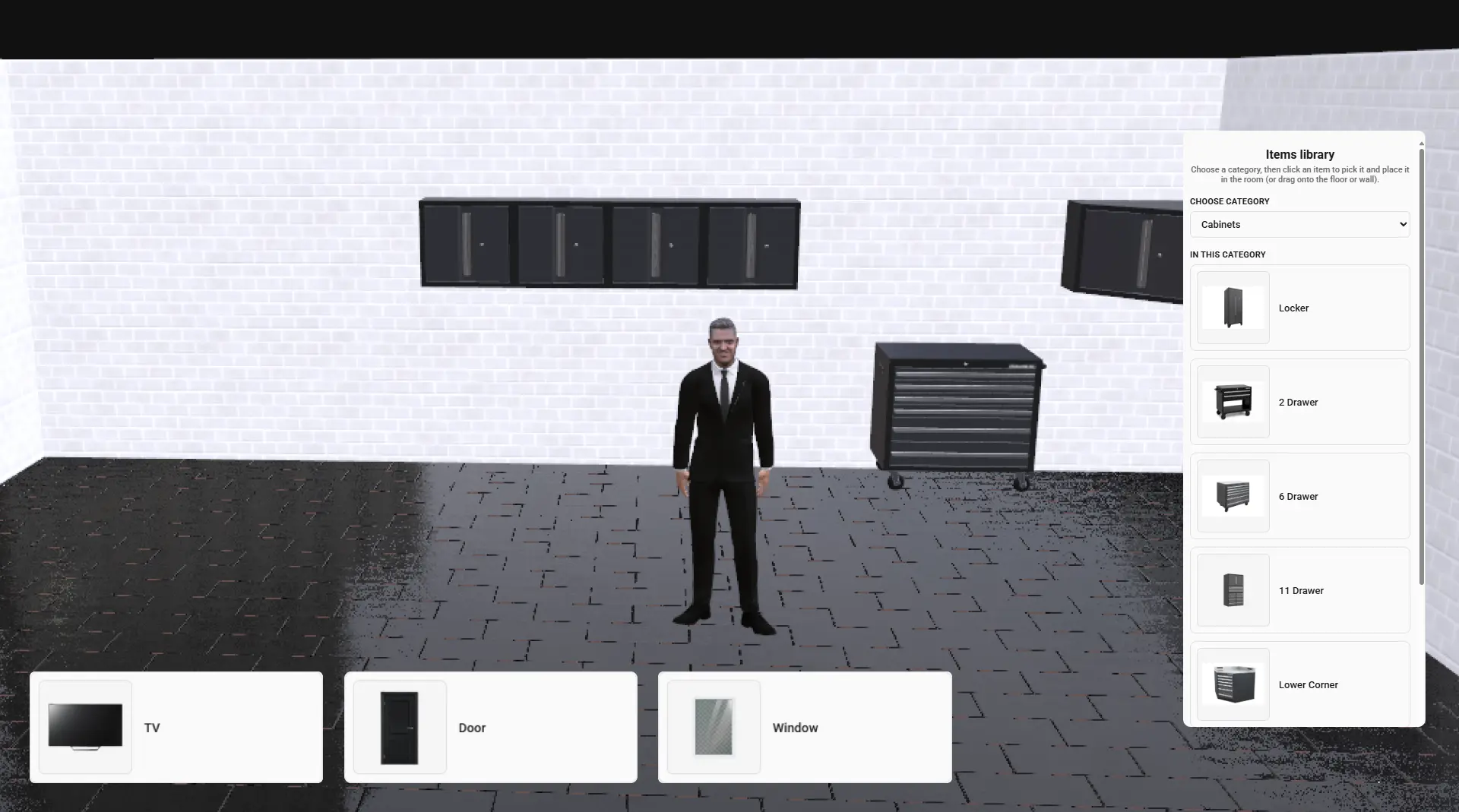
Buying garage storage is a big decision. Cabinets, workbenches and wall systems are expensive, they have to fit a specific space, and they have to look right together. My client, a Pennsylvania brand selling premium garage and workshop furniture since 2016, was asking customers to make that decision from product photos and PDF brochures.
I led a four-person team that replaced that with a 3D planner in the browser. Visitors now build their own garage, fill it with real products and send the company a request that already contains everything sales needs to price it.
Where the old buying journey broke down
The website looked good but did little selling. Five problems kept coming up:
- No sense of fit. Shoppers couldn't tell whether a run of cabinets would fit their wall, or how much floor space would be left.
- Combinations were guesswork. Working out which cabinets, benches and accessories go together meant reading spec sheets side by side.
- Options were hidden. Drawer layouts, door styles, worktops and screens sat in product descriptions that few people read.
- Leads arrived empty. The contact form produced "please call me" messages, and every first sales call started from zero.
- Marketing had nothing to point at. Ads led to static pages with short visits and low intent.
The approach: plan first, then ask for a quote
Instead of adding a 3D viewer to each product page, we made planning the main event. The visitor sets up their room first, and the products, options and quote all happen inside that room.
1. Draw the real space
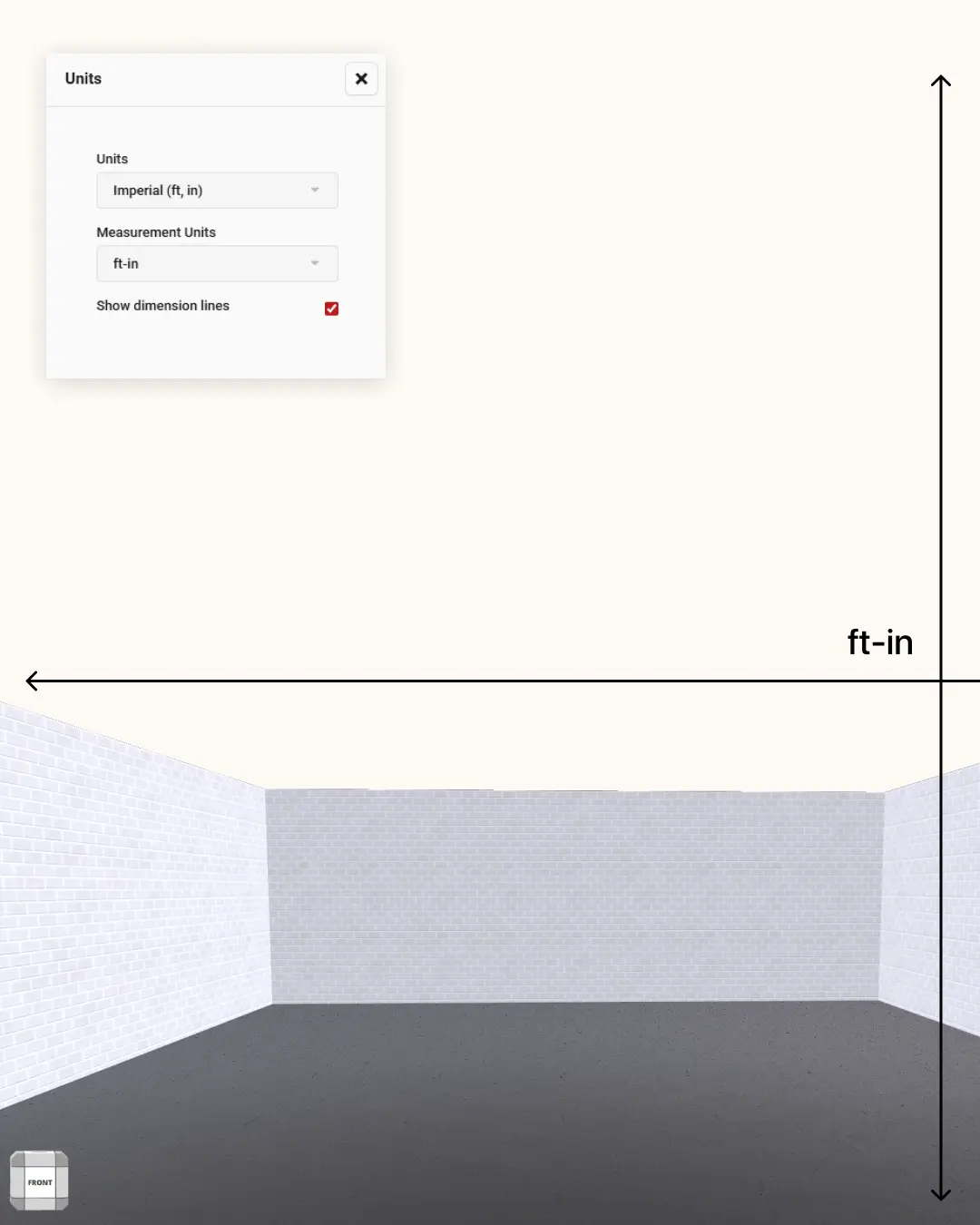
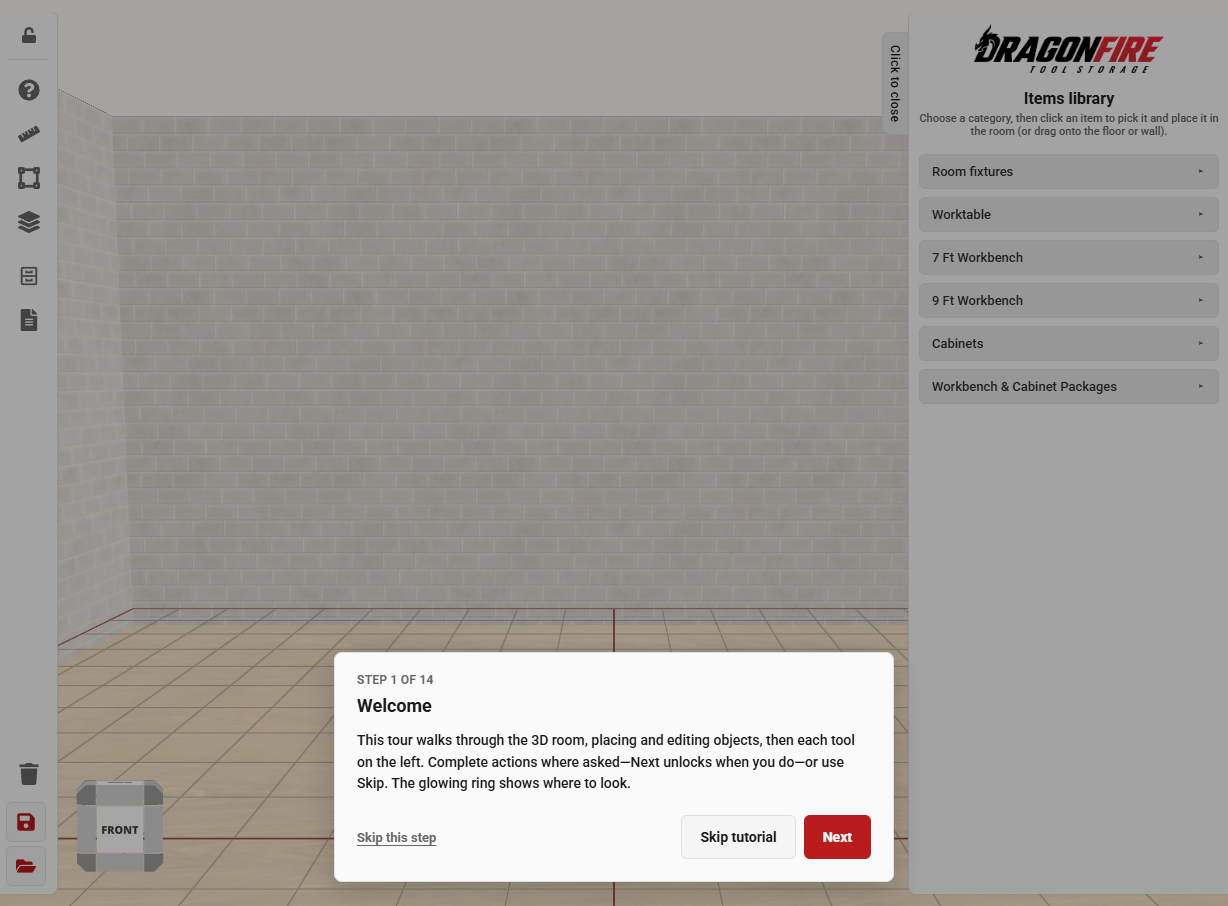
The planner starts with the visitor's own room. They set wall lengths and height, then add doors, windows and fixed items so the layout reflects reality. A life-size reference figure can be switched on, so a cabinet's scale is obvious at a glance.
2. Furnish it from the real catalogue
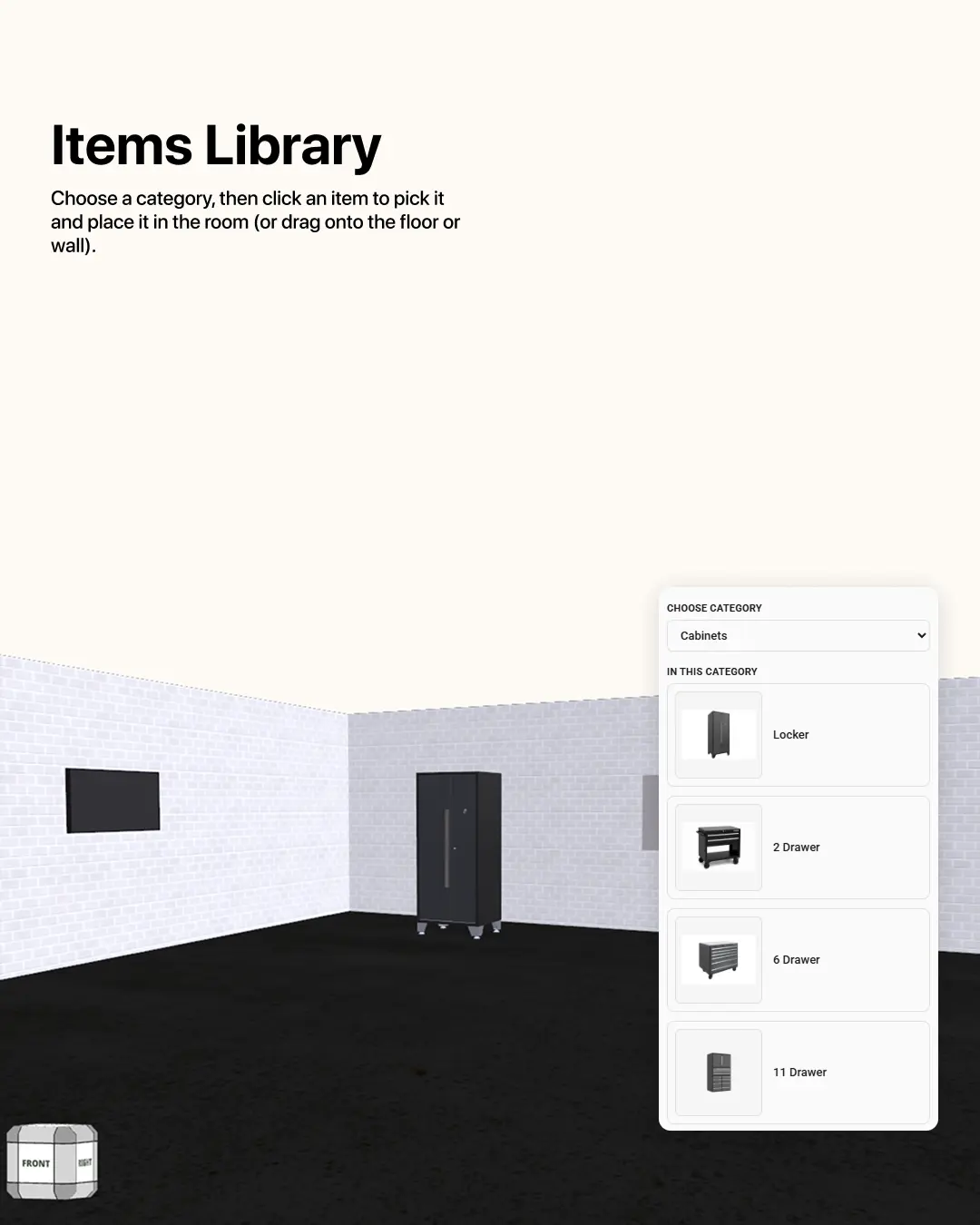
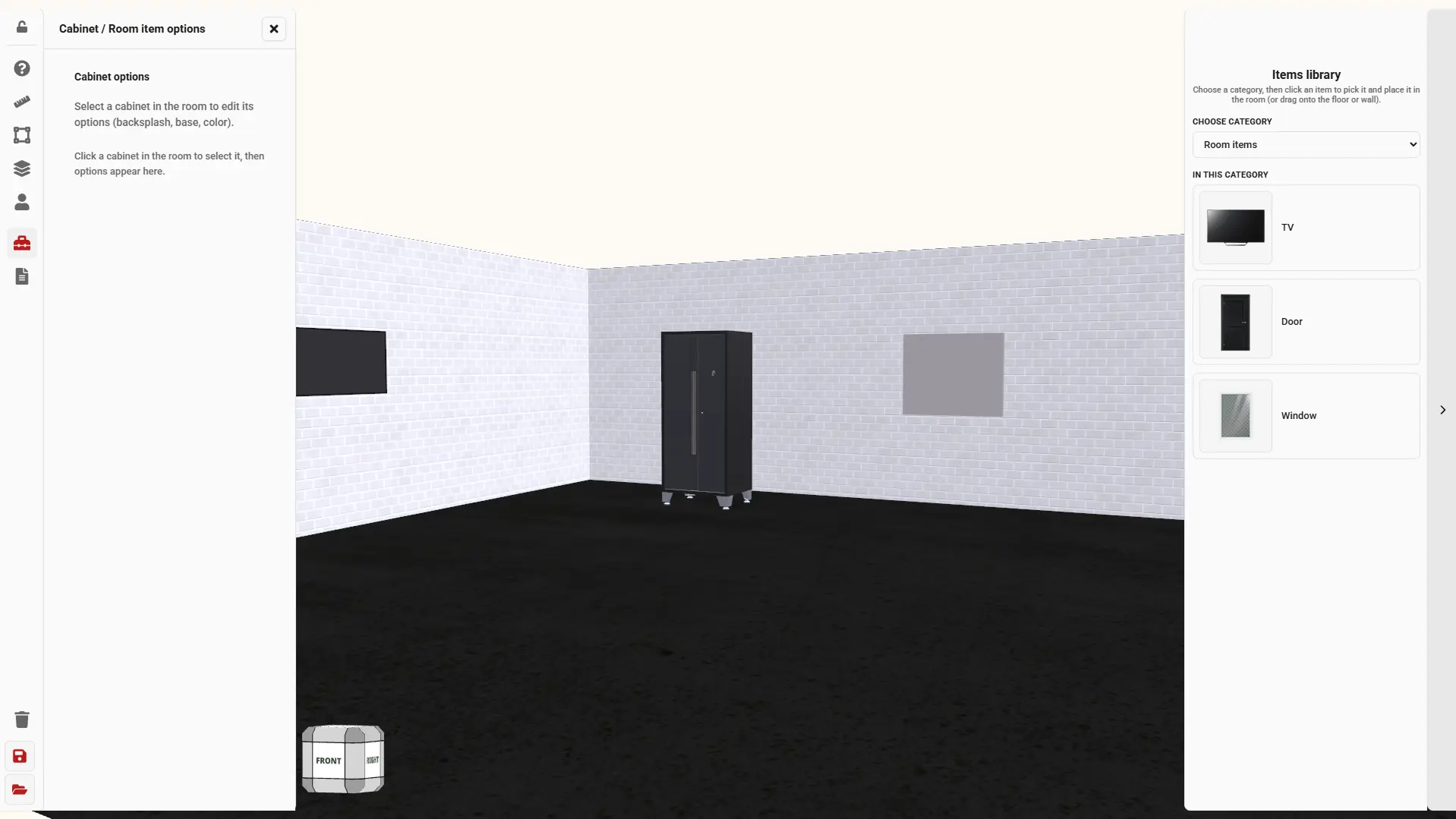
A side panel lists roughly 30 products: tall cabinets, drawer units, workbenches, wall cabinets, corner units and slat-wall storage. Each can be dropped into the room, moved, rotated and snapped against walls. Once placed, a product opens its own options: drawer arrangements, door types, worktop material and edge, add-on screens, and colours and finishes that update live in the scene.
Because the options come with rules, the planner won't produce a combination the factory can't build.
3. Capture the lead at peak interest
The moment someone has spent ten minutes designing their garage is the best moment to ask who they are. Contact details are requested at that point, inside the flow and not on a separate page. We went through several prototypes to find a step that felt natural rather than like a gate.
What reaches the sales team is a complete brief: the customer's name, email and phone, every product with its SKU and chosen options, the full room layout, colour preferences, and delivery notes.
4. Turn the design into a quote request
With one more click the plan becomes a structured quote request, sent at once to the customer and to sales. The first conversation is about price and timing, not "what are you looking for?".
Why we built it rather than bought it
Hosted configurator platforms are quick to start with, but they struggled with four needs here:
| Need | Why a custom build won |
|---|---|
| Shopify depth | Product variants, pricing and cart had to map onto the client's existing Shopify setup, which needed custom middleware |
| The lead flow | Leads had to be structured and routed exactly the way the sales team and CRM expected |
| Product rules | Compatibility between ~30 products, finishes and accessories needed custom constraint logic |
| Ownership | The client owns the interface and can change it freely, with no platform licence or roadmap to wait for |
Eight weeks, four people
| Weeks | Focus |
|---|---|
| 1–2 | Workshops with the client, a review of every product and option, user flows, and how catalogue data maps to Shopify |
| 2–3 | Wireframes and design for the planner, product options, lead and quote screens |
| 3–6 | Three.js scene, product logic, front end, Node.js API, Shopify app |
| 7 | Testing across browsers and devices, checking every option rule, end-to-end lead tests, speed tuning |
| 8 | Launch, handover, documentation and go-live support |
The hardest parts:
- Keeping 3D smooth on ordinary laptops with many detailed products in one scene. This took careful model optimisation and asset loading.
- Mapping configurations to Shopify variants and prices. This needed a custom middle layer, because off-the-shelf Shopify app tooling couldn't handle it.
- Enforcing valid combinations without making the options feel restrictive.

What changed for the business
| Before | After | |
|---|---|---|
| Lead quality | Generic form messages | Every product, option and the room plan included |
| First sales call | Discovery from scratch | Starts from a ready-made configuration |
| Customer confidence | Unsure about size and fit | Layout checked in their own dimensions |
| Website engagement | Short visits to static pages | Long, high-intent planning sessions |
| Quoting | Manual, by email and phone | Structured request created by the customer |
The site stopped being a brochure and became part of the sales team.
What's next
The platform is ready for:
- an AR view so shoppers can see their layout in the real garage through a phone camera,
- live pricing as products are added,
- saved and shareable designs for partners or contractors,
- analytics on popular products and drop-off points, and
- direct CRM sync of each lead and configuration.
If you sell modular, made-to-measure or configurable products, this kind of planner is one of the most direct ways to raise lead quality and shorten the sales cycle.
Related work
Garage Storage 3D Configurator
A browser-based 3D room planner for a Pennsylvania garage-storage brand: customers design their garage with ~30 configurable products and send a quote-ready lead straight from Shopify.

Medical Equipment 3D Configurator
An enterprise 3D configurator for a medical equipment provider in Texas: plan operating rooms in 3D, place equipment with collision and clearance rules, and generate priced PDF quotations.
Layout Planner
A room layout project built with Three.js, React Three Fiber, and JavaScript for a smooth parametric modeling experience in the browser — adjust cabinet layouts and see updates instantly in 3D.
Planning something similar?
Tell me what you're building and I'll reply with a technical take on how I'd approach it.
Get in touch →